

Explaining Repayment History Information (RHI)
Repayment History Information, often referred to as RHI, is a section on a credit report that shows repayments on a credit account. It provides a month-by-month overview showing whether account repayments were made on time or not over a 24-month period.
In simple terms, it helps lenders see if payments were up to date, late, or overdue.
Table of contents:
- How to read your repayment history information (RHI) in your credit report
- Tips for understanding repayment history information (RHI) on your credit report
- Quick note on “worst status” (for the last 24 months)
- FAQ
How to read your repayment history information (RHI) in your credit report
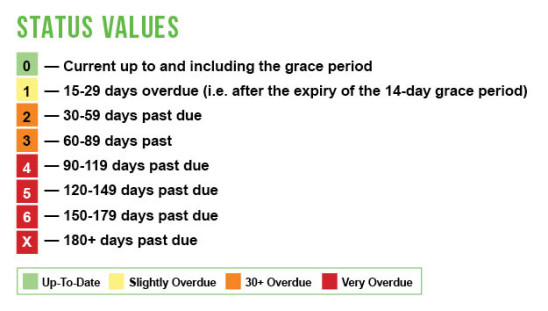
Repayments are typically shown as a 24-month chart (month-by-month) on the credit report. It may be displayed using:
Example 1 (Account 123)

HOW TO READ EXAMPLE 1
In this example, Joanne usually paid her Mortgage (account 123) on time, but missed a payment in October 2024 and in November 2024, making her payment up to 59 days past due (which is shown as a 2 in November). However, she made all necessary repayments (ie. the payments she missed in November and December plus the payment that was due in December) and brought the account payments up to date in December 2024.
In November 2025, Joanne missed her mortgage repayment and the payment was therefore up to 29 days overdue (shown as a 1). She then made a payment in December 2025, which paid off the November payment. However, she missed the December payment which means that the payment was still up to 29 days overdue for December (shown as 1). In January she made a double payment that paid the missed December payment and the January payment that fell due (shown as 0).
Joanne also missed her mortgage payment in May 2026 but made the necessary payments in June 2026 to bring the account up to date.
Example 2 (Account 918)

HOW TO READ EXAMPLE 2
In this example, Joanne’s personal loan payments (account 918) were current and up to date until she missed a payment in March 2025. Joanne then missed the next 5 payments causing the account payments to fall more than 180 days past due (as noted by the x in September 2025).
Tips for understanding repayment history information (RHI) on your credit report:
If you’re looking at the repayment history information (RHI) on your credit report, here are a few things to keep in mind:
- Unlike some ratings or scores, a higher RHI number isn’t better. It generally means a payment was further overdue
- An RHI of ‘0’ is good. It means your payment was up to date. As the RHI number increases, it indicates that a payment was overdue for longer.
- An RHI of ‘X’ means the payment was more than six months overdue.
- The timing of RHI reporting can vary between credit providers. Some providers report your repayment status at the end of each month, so the RHI shown will reflect how overdue your payment was at that point. Others may report at a different time during the month. In either case, the RHI reported reflects how overdue the payment was based on its due date.
Quick note on “worst status” (for the last 24 months)
Consider the worst RHI status over the last 24 months simply as a summary of the most overdue repayment recorded during that period.
Some lenders may look at this value as a quick indicator of risk, but they will usually review the full repayment history rather than relying only on the single worst status.
For more information about repayment history information and how it is shown on a consumer credit report, visit these pages:
FAQ
Does RHI appear on all types of credit accounts?
No, not always. RHI usually appears on credit accounts with regular repayment schedules, such as credit cards, personal loans, and home loans. However, not all credit providers participate in comprehensive credit reporting.
What is the difference between RHI and a default listing?
RHI tracks your repayment history over time, showing if payments are on time or late. A default is a separate, serious mark that appears when a debt is very overdue and meets certain rules.
How long does RHI stay visible on a credit report?
RHI is generally shown as a rolling timeline covering the most recent 24 months of repayment history.
Can RHI be corrected if it’s wrong, and what evidence is strongest?
Yes, you can. The best proof is usually your account statements with due dates and amounts, along with payment confirmations from your bank.
Comprehensive Credit Reporting Participants

June 2022

August 2022

August 2022

September 2022

September 2022

October 2022

January 2023

January 2023

February 2023

March 2023

March 2023

March 2023

March 2023

May 2023

June 2023

July 2023

April 2025

April 2025

April 2026

April 2026

February 2016

May 2016

May 2017

November 2017

February 2018

March 2018

May 2018

June 2018

June 2018

June 2018

June 2018

June 2018

July 2018

September 2018

September 2018

September 2018

September 2018

September 2018

September 2018

September 2018

November 2018

December 2018

November 2018

December 2018

March 2019

May 2019

May 2019

June 2019

July 2019

July 2019

July 2019

September 2019

October 2019

October 2019

November 2019

November 2019

December 2019

February 2020

February 2020

February 2020

June 2020

June 2020

August 2020

September 2020

October 2020

November 2020

January 2021

January 2021

February 2021

February 2021

April 2021

June 2021

June 2021

July 2021

August 2021

October 2021

October 2021

November 2021

December 2021

March 2022

April 2022

May 2022
You may also like